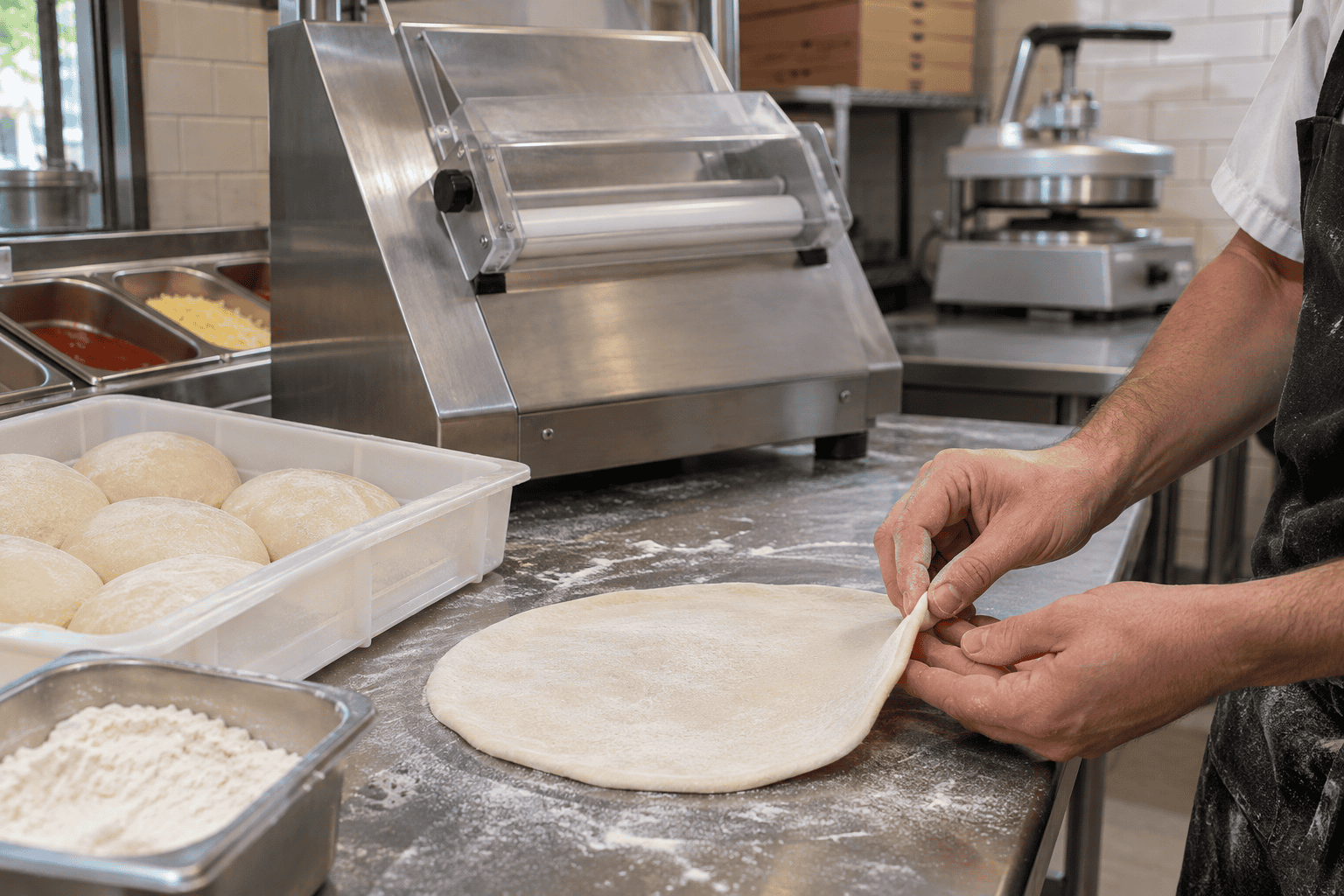
A dough sheeter passes dough through adjustable rollers to create a sheet of controlled thickness. A dough press compresses a dough portion between plates, with heat available on some models. A sheeter is worth testing for menus that need adjustable sheet thickness and several sizes; a press is worth testing for a repeatable flattening cycle. The right choice depends on your dough and finished crust.
For pizza shops preparing for November volume, either machine can address slow forming, but only if that step is the bottleneck. Northern Pizza Equipment offers pizza-focused dough equipment and can help operators compare a machine’s capabilities with their actual production requirements.
Key Takeaways
- Sheeters use rollers; presses use plates. They change dough through different mechanical actions.
- The dough recipe, temperature and relaxation time affect both machines’ results.
- Heated and unheated presses require separate evaluations.
- Measure finished usable crusts per hour, including loading, handling and rework.
- Test your own dough and bake the resulting crust before buying.
Which Dough Forming Method Fits Each Operation?
1. Dough Sheeter
Best for adjustable sheet thickness:
Kitchens producing flattened dough in several sizes or using a roller for more than one approved product. Confirm the roller width, adjustment range and intended dough applications. A pizza roller and a pastry sheeter are not automatically interchangeable.
2. Dough Press
Best for a repeatable pressing cycle:
Operators who can standardize portion weights and dough condition around a plate-based process. Check platen size, thickness control, heat settings and whether staff need to finish the edge after pressing.
3. Hand Forming
Best for when it defines the product:
Shops whose crust identity depends on hand shaping, or whose current volume does not justify a machine. Mechanizing dividing or rounding may help more if shaping itself is already fast and consistent.
How Does a Commercial Dough Sheeter Work?
The operator feeds a portion through rollers set to a selected gap. Depending on the machine, dough passes through one or more stages and may need turning or finishing. Consistent portion weight and feeding technique help produce a repeatable sheet.
The Somerset CDR-2000 listed by Northern Pizza Equipment is a front-operated roller and sheeter for sheets up to 20 inches in diameter. Somerset’s published specifications describe adjustable thickness, removable scrapers and safety sensors. Those details help buyers evaluate menu fit, operator access and cleaning.
How Does a Commercial Dough Press Work?
A press flattens a portion between plates. Some models use heat to assist the process; others use different pressure and control arrangements. Buyers should compare the actual machine rather than treating every product called a dough press as equivalent.
For example, Somerset’s SEP-760 pizza press has an electric drive, thickness adjustment and temperature control. Its workflow differs from a roller even when both machines are used for pizza crust. Confirm the current model’s electrical requirements, plate dimensions and recommended dough preparation before planning a station around it.
Will a Sheeter or Press Change the Crust?
It can. Both methods compress dough and can change how gas is distributed. The effect depends on the recipe, fermentation, dough temperature, machine settings and amount of finishing. Neither method guarantees the open crumb or edge you currently get from hand forming.
Evaluate a complete baked pizza, including its edge, center, bottom and texture after the normal delivery hold. If a dough portion pulls back after forming, examine relaxation time and dough condition before assuming a stronger machine will solve the problem. A machine trial should use the dough as staff actually receive it during service.
How Should a Pizzeria Compare Production Speed?
Measure the entire station. Count taking a dough ball from storage, preparing it, forming it, making any final adjustments and transferring it to the next step. Record rejected or reworked pieces. A fast machine cycle provides little benefit when the operator spends longer loading or correcting the dough.
As an illustrative calculation, if a full station cycle falls from 45 seconds to 30 seconds for 120 crusts, forming time falls from 90 minutes to 60 minutes. That saves 30 minutes at the station under those assumptions. It becomes a payroll saving only if scheduled labor actually falls; otherwise, it provides capacity for other work.
What Workspace and Cleaning Details Matter?
Check the operating footprint as well as the cabinet dimensions. A side-fed roller needs clear approach space; a front-operated machine needs room for loading and collection. A press needs clearance for its open plate and safe access around any heated surfaces. Leave room for dough trays and finished crusts.
Have the operator demonstrate the manufacturer’s cleaning process. Inspect access to scrapers, rollers or plates, and determine which parts are removable. Confirm that the support table, electrical supply and training plan suit the exact model. Keep all guards and safety devices functioning as intended.
What Should Buyers Bring to an Equipment Trial?
- The normal dough recipe, portion weights and fermentation schedule.
- Samples at the temperatures and ages staff encounter during a real shift.
- The largest and smallest crust sizes, including any required raised edge.
- A target for usable crusts per hour and an agreed test for acceptable quality.
- Station measurements, electrical information and cleaning expectations.
Frequently Asked Questions
Is a dough sheeter the same as a dough roller?
The terms overlap in pizza equipment catalogs. Verify how the specific machine feeds dough, its roller configuration and its intended products rather than relying on the product name alone.
Does every dough press heat the dough?
No. Press designs vary. Check whether the selected model has heated plates, how heat is controlled and how that affects the tested recipe.
Can a machine replace all hand stretching?
Sometimes, but many shops still finish the shape or edge by hand. Include that finishing time when comparing equipment and confirm that the baked crust meets the menu standard.
Which machine is better for a small pizza shop?
The better choice fits the dough, available station space and required output. A small shop may need a compact roller, a press or continued hand forming; volume alone does not determine the answer.
Choosing Dough Equipment With Confidence
Choose the machine that produces your approved crust with a repeatable full-station workflow. Compare quality first, then usable output, cleaning effort and total installed cost.
Start with Northern Pizza Equipment’s commercial dough sheeter buying guide and call 800-426-0323 to discuss your dough, menu sizes and production needs. Confirm equipment availability and any test arrangements before scheduling a visit.